

When designing and realising timber facades, fire safety is becoming an increasingly important topic. It is crucial that facades and the materials incorporated into them, in combination with one another, the so-called end use, comply with the required fire classification. In practice, this means that the complete facade build-up, including insulation, must be tested. Leegwater Houtbereiding now has an extensive portfolio of solutions for timber facade cladding in both fire class B and fire class D.
Why apply a fire-retardant treatment?
Fire-retardant treatment of timber is necessary in order to comply with the European fire classifications according to EN 13501. Additional requirements for fire resistance apply in particular to facades higher than 13 metres or located in areas where escape routes are present. A professional and certified treatment is therefore essential.
Flame Delay® by Leegwater
Leegwater Houtbereiding offers various systems for fire-retardant timber under the Flame Delay® brand name:
-
Flame Delay PT®: vacuum pressure impregnation with ammonium phosphate salts, achieving fire class B. This method always requires a suitable coating.
- Flame Delay FX Pro®: a fixating fire retardant that bonds with a polymer binder. As a result, no coating is required, simplifying maintenance.
- Flame Delay SI®: a fire-retardant surface treatment for solid timber facade products. Developed for timber species and applications that do not naturally meet the requirement for fire class D.
All treatments are carried out with precise control of moisture content, impregnation depth and drying. Leegwater only guarantees fire class B when the full process is carried out in-house.
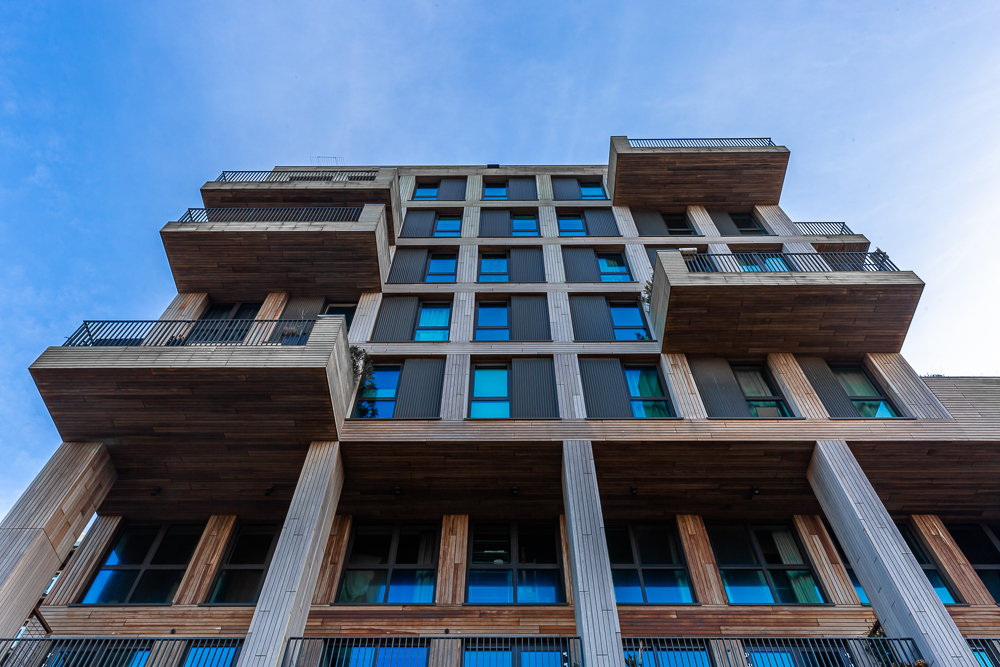
Project: Het Hooghout in Amsterdam
A strong example of fire-retardant timber in practice is the Het Hooghout residential building in Amsterdam. Thermally modified Fraké was selected for this project, treated with Flame Delay® and finished with a Sansin Woodsealer. This combination provides not only fire safety, but also a natural, durable appearance that suits contemporary architecture.

VIEW project
Coating: essential for protection
For treatments based on phosphate salts, a coating is essential to prevent the leaching of salts. Otherwise, this process may lead to paint delamination and a loss of fire-retardant performance. Leegwater therefore developed its own coating system, Colorseen, specifically tailored to our fire retardants and preservation methods.
For lighter shades, we recommend maintenance every 2 to 3 years. Darker colours require maintenance less frequently: once every 5 to 7 years is generally sufficient.
Honest advice for every project
Leegwater not only provides fire-retardant timber, but also actively advises on its applicability in each construction project. A facade made of fire-retardant timber requires attention, care and proper maintenance. That is why we always provide honest advice on feasibility, depending on the facade build-up, accessibility and intended service life.
Read the full article in Houtwereld
In June 2025, the trade journal Houtwereld dedicated an extensive feature article to fire-retardant treatment. Leegwater Houtbereiding was cited as an expert, providing an explanation of our Flame Delay® solutions and working method. Read the article on fire-retardant treatment in Houtwereld (pdf) (dutch).

